
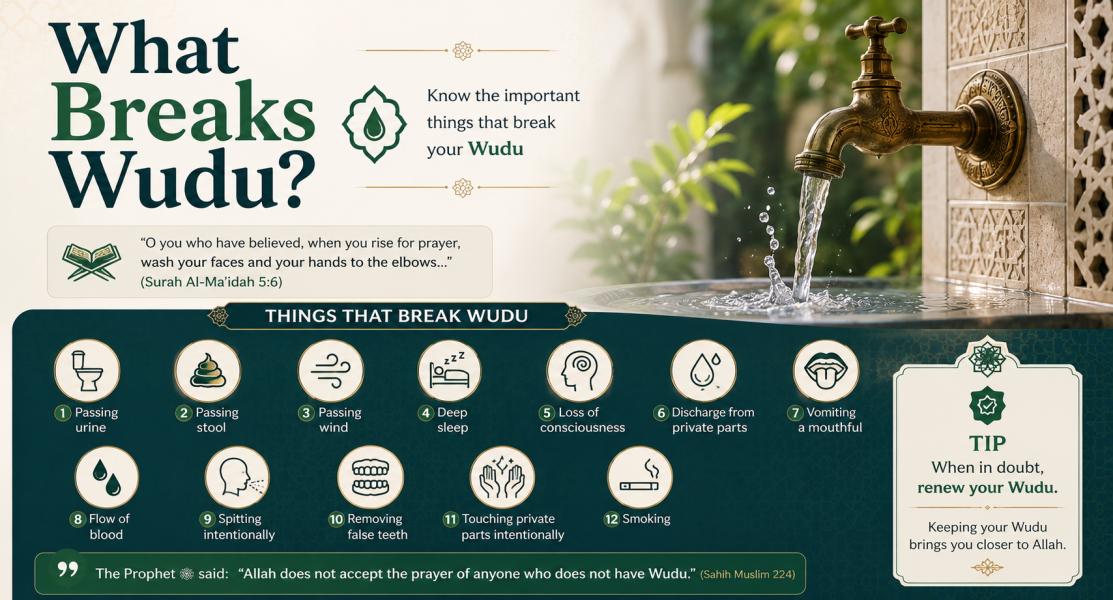
What Breaks Wudu? A Complete Guide Every Muslim Should Know
Wudu (ablution) is one of the most important acts of purification in Islam. It prepares Muslims to stand before Allah in prayer and is required before performing Salah, touching the Mushaf according to many scholars, and certain other acts of worship.
Knowing what breaks Wudu is essential because praying without valid purification makes the prayer invalid.
Allah says in the Qur'an:
"O you who believe! When you rise to pray, wash your faces and your hands up to the elbows..."
(Surah Al-Ma'idah 5:6)
This verse establishes the importance of purification before prayer.
What Is Wudu?
Wudu is the ritual washing of specific parts of the body before acts of worship, particularly Salah. It is both a physical and spiritual purification that prepares the believer to worship Allah.
The Prophet ﷺ emphasized maintaining Wudu throughout the day whenever possible.
What Breaks Wudu?
According to the Qur'an and authentic Sunnah, the following actions invalidate Wudu.
1. Anything That Comes Out from the Private Parts
This includes:
- Urination
- Defecation
- Passing gas
These are unanimously agreed upon by Islamic scholars as nullifiers of Wudu.
2. Deep Sleep
Sleeping deeply in a way that causes loss of awareness breaks Wudu.
Light sleep while remaining aware generally does not invalidate Wudu.
The determining factor is whether a person loses awareness of their surroundings.
3. Loss of Consciousness
Wudu is broken if a person loses consciousness due to:
- Fainting
- Intoxication
- Anesthesia
- Severe illness
Once awareness returns, a new Wudu should be performed.
4. Sexual Discharge
The release of sexual fluids invalidates Wudu.
If major impurity (Janabah) occurs, then Ghusl (full ritual bath) becomes obligatory before prayer.
5. Touching the Private Parts (Scholarly Difference)
Many scholars, based on authentic narrations, hold that directly touching one's private parts without a barrier invalidates Wudu.
Other scholars have a different opinion.
Because there is a recognized scholarly difference, Muslims should follow reliable scholarly guidance they trust.
Things That Do NOT Break Wudu
Many Muslims mistakenly believe these actions invalidate Wudu, but according to many scholars they do not:
- Laughing outside of Salah
- Crying
- Cutting hair
- Cutting nails
- Bleeding from a minor wound (subject to scholarly differences)
- Vomiting (subject to scholarly differences)
- Touching your spouse (subject to scholarly differences)
- Eating ordinary food
Does Sleeping Always Break Wudu?
Not necessarily.
- Light sleep while sitting and maintaining awareness generally does not invalidate Wudu.
- Deep sleep with complete loss of awareness does.
The Prophet ﷺ and his companions sometimes dozed while waiting for prayer and then prayed without renewing Wudu.
Tips for Maintaining Wudu
Keeping Wudu throughout the day is a beautiful Sunnah.
You can make it easier by:
- Performing Wudu before leaving home.
- Renewing Wudu before every Salah.
- Avoiding unnecessary delays after using the restroom.
- Learning the Sunnah supplications after Wudu.
- Teaching children the importance of purification.
The Virtues of Wudu
The Prophet ﷺ mentioned many virtues of maintaining purification.
Among them:
- Sins are forgiven with every drop of water.
- Wudu is half of purification.
- Believers will be recognized on the Day of Judgment by the brightness of the limbs washed in Wudu.
- It prepares the heart for prayer and remembrance of Allah.
Stay Spiritually Prepared with Zabi
Zabi helps Muslims maintain their daily worship with practical Islamic tools, including:
- Accurate Prayer Times
- Qibla Direction
- Daily Duas & Adhkar
- Holy Qur'an
- Islamic Calendar
- AI Islamic Assistant
- Educational Islamic Articles
- Prayer Reminders
Whether you're learning about purification or strengthening your daily worship, Zabi is here to support your journey.
Conclusion
Understanding what breaks Wudu helps ensure that our prayers are performed correctly and with sincerity. Purification is not merely a physical act—it is a means of preparing our hearts to stand before Allah.
By learning the rulings of Wudu and practicing them consistently, we can worship Allah with confidence and devotion.
May Allah ﷻ grant us purity in both body and heart, accept our prayers, and make us among those who love cleanliness and worship. Ameen.
Frequently Asked Questions
Does passing gas break Wudu?
Yes. Passing gas is one of the agreed-upon nullifiers of Wudu.
Does bleeding break Wudu?
Minor bleeding is generally not considered to break Wudu by many scholars, although there is scholarly disagreement on this issue.
Does sleeping always invalidate Wudu?
Deep sleep that causes loss of awareness breaks Wudu. Light sleep generally does not.
Does touching my spouse break Wudu?
There is a difference of scholarly opinion regarding this matter. Follow the view of a trusted scholar or school of jurisprudence.
Should I renew Wudu if I am unsure whether it was broken?
The Prophet ﷺ taught that certainty is not removed by doubt. If you are certain you had Wudu and only doubt whether it was broken, you should consider your Wudu to remain valid until you are certain that it was invalidated.
Reference: Sahih al-Bukhari (137) and Sahih Muslim (361)