
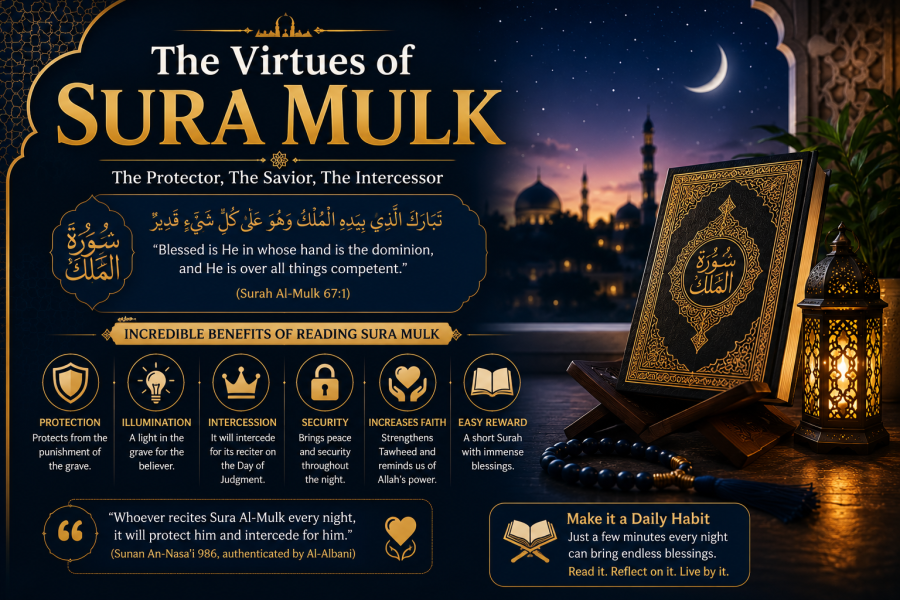
The Virtues of Surah Al-Mulk: Why Every Muslim Should Read It Every Night
Surah Al-Mulk (Chapter 67 of the Holy Qur'an) is one of the most beloved chapters of the Qur'an. Consisting of 30 verses, it reminds believers of Allah's supreme authority, His perfect creation, and the reality of the Hereafter.
The Prophet Muhammad ﷺ encouraged Muslims to recite this Surah regularly because of its tremendous virtues and blessings.
Making Surah Al-Mulk part of your nightly routine is a simple Sunnah that brings lasting spiritual rewards.
Allah says:
"Blessed is He in whose Hand is dominion, and He is over all things competent."
(Surah Al-Mulk 67:1)
What Is Surah Al-Mulk About?
Surah Al-Mulk focuses on several important themes:
- The greatness and sovereignty of Allah
- Reflection upon His creation
- Accountability on the Day of Judgment
- The reward of believers
- The punishment of disbelief
- Complete reliance upon Allah
It strengthens faith by reminding us that every blessing and every test comes from Allah alone.
Why Is Surah Al-Mulk So Special?
Among all chapters of the Qur'an, Surah Al-Mulk has unique virtues mentioned in authentic narrations.
The Prophet ﷺ said:
"There is a Surah in the Qur'an consisting of thirty verses that intercedes for its companion until he is forgiven. It is Surah Al-Mulk."
Reference: Sunan Abu Dawud (1400), Jami' at-Tirmidhi (2891)
1. It Intercedes for the Believer
One of the greatest virtues of Surah Al-Mulk is that it intercedes for the one who recites it regularly.
On the Day of Judgment, by Allah's permission, it will plead for its reciter until forgiveness is granted.
2. Protection from the Punishment of the Grave
Many scholars mention authentic reports highlighting that Surah Al-Mulk is a means of protection from the punishment of the grave for those who recite it consistently.
For this reason, many Muslims make it part of their nightly worship.
3. Strengthens Faith in Allah
Surah Al-Mulk repeatedly reminds us of Allah's:
- Power
- Wisdom
- Knowledge
- Mercy
- Control over life and death
Reflecting upon these verses increases trust (Tawakkul) and strengthens Iman.
4. Encourages Reflection
Allah repeatedly asks us to observe His creation.
The heavens, the earth, birds in flight, and every aspect of the universe point to His greatness.
Reading Surah Al-Mulk develops gratitude and contemplation.
5. Builds a Nightly Connection with the Qur'an
Reciting just one chapter before sleeping creates a beautiful habit of ending the day with the remembrance of Allah.
Even a few minutes every night can transform your spiritual life.
When Should You Read Surah Al-Mulk?
Many scholars recommend reading Surah Al-Mulk every night before going to sleep.
This follows the practice encouraged through authentic narrations regarding its virtues.
Consistency is more important than reading it occasionally.
Tips for Making It a Daily Habit
- Read it before sleeping every night.
- Keep a Qur'an beside your bed.
- Read the translation along with the Arabic.
- Listen to its recitation during your evening routine.
- Memorize a few verses each week.
- Reflect on the meanings rather than rushing through the recitation.
Lessons We Learn from Surah Al-Mulk
This remarkable Surah teaches us:
- Allah alone owns all dominion.
- Every soul will return to Him.
- This worldly life is a test.
- Paradise is the reward for sincere believers.
- Reflecting on Allah's creation strengthens faith.
- Success comes through obedience and remembrance of Allah.
Read Surah Al-Mulk with Zabi
Zabi helps Muslims build a consistent relationship with the Qur'an by providing:
- Complete Holy Qur'an
- Audio Recitation
- Daily Duas & Adhkar
- Prayer Times
- Qibla Direction
- Islamic Calendar
- AI Islamic Assistant
- Authentic Islamic Articles
Whether you're reading Surah Al-Mulk every night or exploring the Qur'an daily, Zabi is your trusted companion for Islamic learning and worship.
Conclusion
Surah Al-Mulk is more than a chapter to recite—it is a reminder of Allah's greatness, a source of spiritual reflection, and a means of immense reward.
By reading it every night with sincerity and understanding, we strengthen our faith and keep our hearts connected to the Qur'an.
May Allah ﷻ make us among those who recite the Qur'an regularly, reflect upon its meanings, and benefit from its guidance in this life and the Hereafter. Ameen.
Frequently Asked Questions
How many verses are in Surah Al-Mulk?
Surah Al-Mulk contains 30 verses.
When should I read Surah Al-Mulk?
It is recommended to recite it every night before sleeping.
What is the main virtue of Surah Al-Mulk?
Authentic hadith mention that it intercedes for its regular reciter and is a means of forgiveness by Allah's permission.
Can I listen to Surah Al-Mulk instead of reading it?
Listening is beneficial, but reciting it yourself while reflecting on its meaning is encouraged whenever possible.
How long does it take to recite Surah Al-Mulk?
Most people can complete its recitation in 7–10 minutes, depending on their pace.