
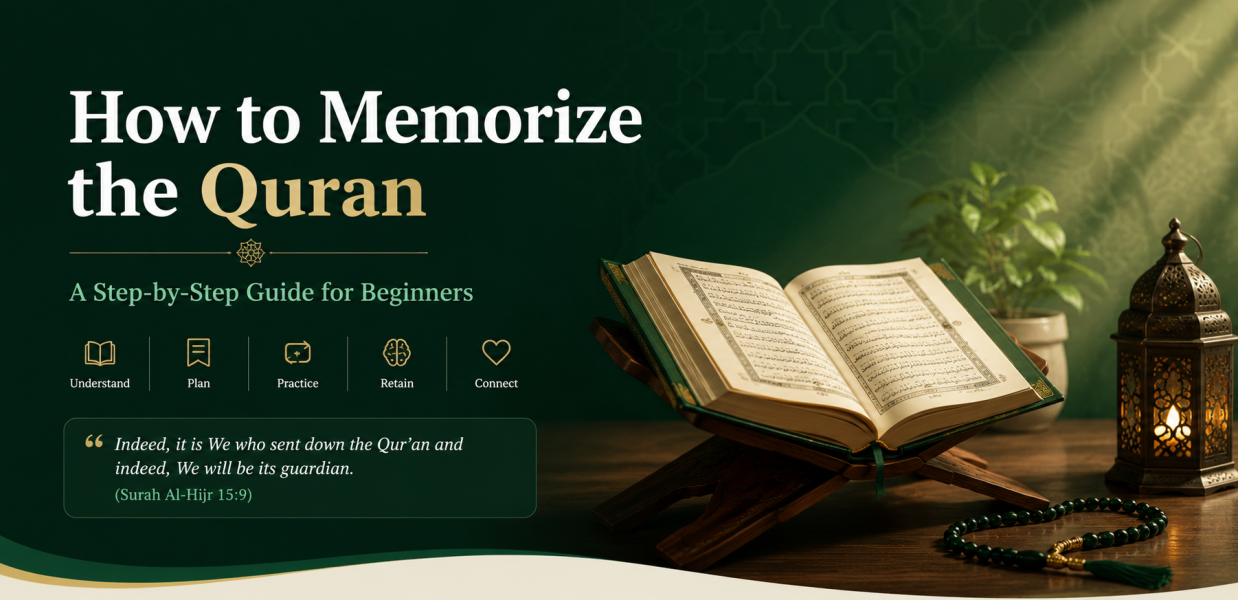
How to Memorize the Quran: A Step-by-Step Guide for Beginners
Have you ever wished you could carry the words of Allah ﷻ in your heart? Memorizing the Quran — known as Hifz — is one of the most noble and rewarding acts a Muslim can undertake. The Prophet ﷺ said: "The best among you are those who learn the Quran and teach it." (Bukhari)
Yet for many beginners, the question of how to memorize Quran feels overwhelming. With 6,236 verses across 114 surahs, where do you even start? The good news: thousands of Muslims — of all ages and backgrounds — complete their hifz every year using simple, proven methods that anyone can follow.
This guide will walk you through everything you need to know: from which surah to start with, to the exact daily schedule that works, to the most common mistakes that slow memorizers down. By the end, you will have a clear, realistic roadmap to begin your Quran memorization journey today.
Is It Possible to Memorize the Quran as an Adult?
Absolutely — yes. While children's minds absorb language exceptionally well, adults have powerful advantages: stronger discipline, deeper motivation, and the ability to understand meaning as they memorize. Many people complete their hifz in their 30s, 40s, and beyond.
The key is consistent daily practice — even 20 to 30 minutes a day will produce remarkable results over time. What separates successful memorizers from those who give up is not intelligence or natural talent, but a structured method and unwavering consistency.
✦ Islamic Insight
Ibn Mas'ud (RA) reported that the companions of the Prophet ﷺ used to not move on from ten verses until they had understood and acted upon them. Memorization and understanding go hand in hand.
Where to Start: The Beginner's Roadmap with Juz Amma
The most widely recommended starting point for beginners is Juz Amma — the 30th and final Juz of the Quran. Here is why it is perfect for new memorizers:
- The surahs are short, making each memorization goal feel achievable
- The language is rhythmic and musical, making it easier to retain
- Most Muslims already know parts of it from daily prayers — you have a head start
- It builds confidence before moving to longer surahs in earlier Juz
After completing Juz Amma, most students proceed to Juz 29, then Juz 1 (Al-Fatiha and Al-Baqarah). The most important thing is to follow a structured order rather than jumping between unrelated surahs.
The 3-Step Repetition Method: How to Actually Make It Stick
This is the core technique used by hifz schools (madrasas) around the world. It divides your memorization into three distinct layers:
STEP : 1
New Verse (Al-Jadeed)
Memorize 3 to 5 new verses each day. Repeat each verse individually at least 20 times before moving to the next. Then recite all new verses together 10 more times. Do NOT move on until you can recite without looking.
STEP : 2
Recent Revision (Sabqi)
Revise everything you memorized in the past 7 days. This is the most critical step — new memorization is fragile and disappears quickly without reinforcement. Dedicate at least as much time to this as to new memorization.
STEP : 3
Old Revision (Manzil)
Every week, revise a larger section of what you memorized long ago. Divide your total memorized portion into 7 parts and review one part per day. This keeps older memorization fresh in your long-term memory.
The ratio to aim for: spend 1 part new memorization to 2 parts revision. Most beginners make the mistake of focusing too much on new verses and too little on revision — then they forget what they learned weeks ago.
Your Daily Hifz Schedule: 15-Minute vs 1-Hour Plans
The best hifz schedule is the one you can actually stick to. Here are two realistic plans:
Time
15-Minute Daily Plan
1-Hour Daily Plan
New memorization
1 verse
5 new verses
Sabqi (recent) revision
3 verses from past week
Previous 2 days' memorization
Manzil (old) revision
1 page from older portion
Half a Juz from total memorized
Estimated completion
Juz Amma in ~6 months
Full Quran in 2–3 years
The best time for hifz is right after Fajr, when the mind is fresh and the world is quiet. The Prophet ﷺ made dua for barakah in the early morning hours, and memorizers across centuries have confirmed that Fajr time produces the clearest retention.
Using Zabi App to Support Your Hifz Journey
Technology, when used wisely, can be a powerful ally in Quran memorization. The Zabi Islamic Companion App offers several tools designed specifically to support memorizers:
- Full Quran with audio from 15+ certified reciters — listen and repeat with a single tap
- Verse-by-verse playback — set any ayah on loop to drill difficult passages
- Daily Quran reading reminders — stay consistent even on busy days
- Zabi AI assistant — ask questions about tajweed rules or verse meanings in real time
- Prayer time alerts — ensuring your ibadah rhythm supports your hifz routine
📱 Try Zabi for Free
Download the Zabi app and use the Quran audio feature to perfect your pronunciation while you memorize. Available now at zabi.theme29.com
7 Common Mistakes That Slow Down Memorization
Knowing what not to do is just as important as following the right method. Avoid these traps:
✗ Memorizing too much too fast
Going from 2 to 15 verses a day sounds impressive — until you forget everything in two weeks. Slow and steady wins.
✗ Skipping revision days
Missing even one day of Sabqi revision weakens the chain. If you must miss a day, do double revision the next day.
✗ Memorizing without understanding
You do not need to be an Arabic scholar, but read the translation of what you are memorizing. Understanding aids memory significantly.
✗ Using multiple Mushaf editions
Your brain forms visual memory of the page layout. Switch between editions and your recall is disrupted. Stick to one edition — preferably the Madinah Mushaf.
✗ Memorizing in a noisy environment
Background noise degrades verbal retention. Find a quiet space, ideally after Fajr before the household wakes.
✗ Not listening to a qualified reciter
Reading silently from text alone builds weak recall. Always pair memorization with audio from a skilled, certified reciter.
✗ Losing motivation and stopping
Hifz is a marathon, not a sprint. Connect your memorization to spiritual meaning rather than just achievement. Make dua consistently.
Duas for Memory and Retention from the Sunnah
Before sitting down to memorize, it is Sunnah to make dua for ease and retention. The following duas are established from the Quran and authentic hadith:
Dua for Knowledge (Quran 20:114)
رَبِّ زِدۡنِي عِلۡمًا — Rabbi zidni 'ilma
"My Lord, increase me in knowledge."
Recite this before every memorization session.
Dua for a Retentive Memory (Tirmidhi)
اللَّهُمَّ ارْحَمْنِي بِتَرْكِ مَعَاصِيكَ أَبَدًا مَا أَبْقَيْتَنِي
"O Allah, be merciful to me by enabling me to avoid Your disobedience forever as long as You keep me alive, and by making me do that which will please You in a way that brings me Your pleasure."
Scholars have noted that sins weaken memory, while acts of worship — especially staying in wudu, night prayers, and avoiding haram entertainment — strengthen it. Your lifestyle outside the memorization session matters as much as the session itself.
Finding an Accountability Partner or Sheikh
No serious memorizer does it entirely alone. Having someone to recite to — whether a qualified teacher, a hifz partner, or even a family member — dramatically improves retention and accountability.
- Recite to a teacher weekly: even one session per week of reciting in front of a qualified Sheikh strengthens your hifz more than any app
- Join a hifz circle: many mosques run weekend or evening Quran circles for adults — look for one in your area
- Partner up: find a friend at the same stage and quiz each other daily over a voice message
- Share your progress online: the Muslim online community is warm and encouraging — accountability posts work
Conclusion: Your Hifz Journey Starts Today
Memorizing the Quran is not a sprint — it is a lifelong act of devotion, commitment, and love for the words of Allah ﷻ. The method is clear, the path is proven, and the reward is immeasurable. As the Prophet ﷺ said: "The one who is proficient in the recitation of the Quran will be with the honourable and obedient scribes (angels), and the one who recites the Quran with difficulty, stammering or stumbling through its verses, will have two rewards." (Muslim)
Whether you memorize one verse a day or five, in 15 minutes or an hour — what matters is that you begin. Open Surah Al-Ikhlas right now, read it 20 times, and you have taken your first step.
Start Your Hifz Journey with Zabi
The Zabi Islamic Companion App gives you full Quran audio with 15+ reciters, verse-by-verse playback, daily reading reminders, and an AI Islamic assistant — everything you need to memorize, understand, and live the Quran.
Download Zabi Free → zabi.theme29.com
Related Articles
- How to Never Miss Fajr: 7 Proven Morning Prayer Habits
- Best Quran Reciters in the World: Top 10 to Listen To
- How to Learn Tajweed for Beginners: Rules, Resources & Practice Plan
- Morning and Evening Duas: Complete List with Arabic, Transliteration & Meaning
© 2026 Zabi Islamic Companion App | zabi.theme29.com | SEO Blog Series