
How to Calculate Zakat Correctly: A Complete Step-by-Step Guide
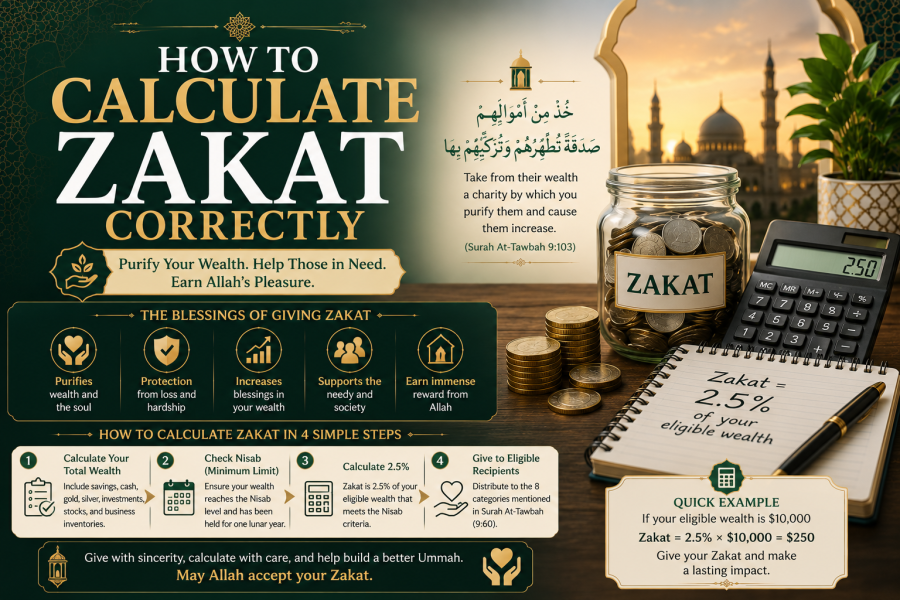
Zakat is one of the Five Pillars of Islam and an essential act of worship that purifies wealth and supports those in need. Every eligible Muslim who possesses wealth above a certain threshold (Nisab) for one lunar year must pay 2.5% of their qualifying wealth.
Many Muslims find Zakat calculations confusing, but once you understand the basic principles, it becomes straightforward.
Allah says in the Qur'an:
"Take from their wealth a charity by which you purify them and cause them increase."
(Surah At-Tawbah 9:103)
What Is Zakat?
Zakat is an obligatory charity that Muslims give annually on qualifying wealth. It is not simply an act of generosity—it is an obligation that purifies wealth, supports the needy, and strengthens the Muslim community.
The word "Zakat" means purification and growth, reminding us that giving for the sake of Allah brings blessings rather than reducing our wealth.
Who Must Pay Zakat?
You are required to pay Zakat if:
- You are a Muslim.
- You own wealth above the Nisab threshold.
- Your wealth has remained above the Nisab for one lunar year (Hawl).
What Is Nisab?
Nisab is the minimum amount of wealth a Muslim must own before Zakat becomes obligatory.
Traditionally, Nisab is based on either:
- 85 grams of gold, or
- 595 grams of silver
Many scholars encourage checking the current market value of gold or silver to determine the applicable Nisab.
What Wealth Is Subject to Zakat?
Generally, Zakat is due on:
Cash
- Cash in hand
- Bank balances
- Savings accounts
Gold & Silver
- Gold jewelry (scholarly opinions vary regarding personal jewelry)
- Gold bars
- Silver items
- Precious metals
Business Assets
- Merchandise for sale
- Business inventory
- Trading stock
Investments
- Shares and stocks (depending on their nature)
- Investment funds
- Profits from investments
Money Owed to You
Money that is expected to be repaid can generally be included, according to many scholars.
What Is Not Subject to Zakat?
Generally, Zakat is not due on:
- Your primary residence
- Personal clothing
- Household furniture
- Personal vehicle
- Everyday electronics
- Personal-use items
These items are not considered Zakatable wealth when used for personal living.
How to Calculate Zakat
Follow these simple steps:
Step 1: Calculate Your Total Assets
Add together:
- Cash
- Savings
- Gold
- Silver
- Investments
- Business inventory
- Money owed to you
Example:
Cash: $6,000
Savings: $8,000
Gold: $3,500
Investments: $2,500
Total Assets = $20,000
Step 2: Deduct Immediate Liabilities
Subtract debts that are currently due, such as:
- Outstanding bills
- Short-term business debts
- Immediate loan repayments
Example:
Current liabilities = $2,000
Net Zakatable Wealth = $18,000
Step 3: Check the Nisab
If your remaining wealth is above the current Nisab value and has remained so for one lunar year, Zakat becomes obligatory.
Step 4: Calculate 2.5%
The Zakat rate is:
2.5% (1/40)
Example:
$18,000 × 2.5% = $450
Your Zakat due would be $450.
Who Can Receive Zakat?
The Qur'an specifies eight categories of eligible recipients in Surah At-Tawbah (9:60), including:
- The poor
- The needy
- Those employed to administer Zakat
- Those whose hearts are to be reconciled
- Those in bondage
- People in debt
- In the cause of Allah
- The stranded traveler
It is important to ensure that Zakat reaches those who are genuinely eligible.
Common Mistakes to Avoid
- Forgetting cash held in different accounts.
- Ignoring business inventory.
- Paying Zakat before checking Nisab.
- Forgetting investment assets.
- Calculating on gross wealth without deducting eligible short-term liabilities.
- Delaying Zakat without a valid reason.
Benefits of Giving Zakat
Zakat is more than a financial obligation—it is a means of spiritual growth.
It helps to:
- Purify wealth
- Support those in need
- Reduce poverty
- Strengthen the Muslim community
- Increase gratitude
- Earn immense rewards from Allah
The Prophet ﷺ said:
"Charity does not decrease wealth."
Reference: Sahih Muslim (2588)
Calculate Your Zakat with Zabi
Zabi makes fulfilling your Zakat obligation easier through helpful Islamic tools, including:
- Zakat Calculator
- Prayer Times
- Holy Qur'an
- Daily Duas & Adhkar
- Islamic Calendar
- Qibla Direction
- AI Islamic Assistant
- Authentic Islamic Articles
Use the built-in Zakat Calculator in Zabi to estimate your annual Zakat quickly and accurately.
Conclusion
Zakat is one of the most beautiful acts of worship in Islam. It purifies our wealth, helps those in need, and reminds us that every blessing ultimately belongs to Allah.
By understanding the basic principles of Nisab, eligible wealth, and the 2.5% calculation, every Muslim can confidently fulfill this important pillar of Islam.
May Allah ﷻ accept our Zakat, bless our wealth, and make us among those who give sincerely for His sake. Ameen.
Frequently Asked Questions
How much Zakat do I pay?
The standard Zakat rate is 2.5% of your qualifying wealth after deducting eligible short-term liabilities.
What is Nisab?
Nisab is the minimum amount of wealth a Muslim must possess before Zakat becomes obligatory. It is traditionally based on the value of 85 grams of gold or 595 grams of silver.
Do I pay Zakat on my house?
No. Your primary residence used for personal living is generally not subject to Zakat.
Is Zakat due on savings?
Yes. Savings held above the Nisab for one lunar year are generally subject to Zakat.
Can I calculate my Zakat using the Zabi app?
Yes. The Zabi Zakat Calculator helps you estimate your Zakat by entering your qualifying assets and liabilities, making the calculation simple and convenient.